

My first large-scale experiment with AI programming didn’t go so well. I used Claude Code and told it to generate an Android version of an iOS app. About 90 minutes later, it had produced a passable version of the app’s home screen, but nothing else. I had to redirect it several times to fix errors and get something that would build. It cost me $67.
I’d say it failed to give me a commercially useful result, but I learned a lot. Later that day I was using it easily to do smaller incremental tasks. Then I signed up for a company account and invited my team.
AI is coming for our jobs. That’s the prediction, the fear, the worry that we hear every day. Some say it’s here already, others will tell you it’s coming in so many months or years. The closer you are to the technology, the sooner you expect it to disrupt everything. Is it for real?
My company writes software as a service. I work with dozens of business customers so I have access to a wide range of input. I don’t yet have any customer who is outright using AI to replace our services. Most are more interested in putting AI in their products or on their web sites. A few will ask ChatGPT for bits of advice and pass them on to me. I use ChatGPT too, so I have access to the same information.
I don’t doubt the day will come when non-programmers will be able to build viable applications without coding. But there are different kinds of non-programmers. A competent and detail-oriented worker who understands their business should get good results. An executive who’s used to barking out vague commands to their underlings isn’t going to get what they want.
This leaves a window for us to take advantage. Right now people still need a developer to guide the AI tools, give them coherent instructions, check their results. If you code, you should absolutely have these tools at your disposal and use them. Generating complete applications from scratch, while possible, isn’t the only way to go. You can ask for individual features, review them, and make sure you understand them before you accept the code. Even if you’re not using AI for codewriting you should at least be using it for code review or to do mindless refactoring jobs.
I don’t think larger and more conservative businesses are getting ready to replace their entire coding teams with AI. When a business is using technology, rather than selling it as a product, computers are a means to an end, and technological progress isn’t always a priority. I’ve run into plenty of cases where decades-old equipment and software were happily being used on a daily basis. Everything evolves eventually, and we must be prepared for the future, but we shouldn’t ignore the present either.
Long term? We’ve trained AI to be good at writing software, but it begs the question of whether much of the software we use today will even make sense in a future of ubiquitous AI. Why do you need a calendar app when you can just ask your AI assistant to remember your appointments? Why do you need tax preparation software when you can just say, “Do my taxes”? Will IDEs, filled with screens and options and plug-ins, be necessary when AI is writing most of our code?
Will we even need need languages like Swift, Java, or Kotlin when AI can spit out the executable code directly? Even the elite developers who make our most important programming tools aren’t safe.
I like writing software. I’ve been doing it more than four decades. Even if I have AI writing code for me at work, I’ll still maintain my personal applications by hand, much like a woodworker is going to keep building furniture in his garage that cannot compete with the flat-pack fiberboard from Ikea. Even then, I’ll at least point my AI tools at my code and ask them to review it. Not to save time, but to see what I can learn.
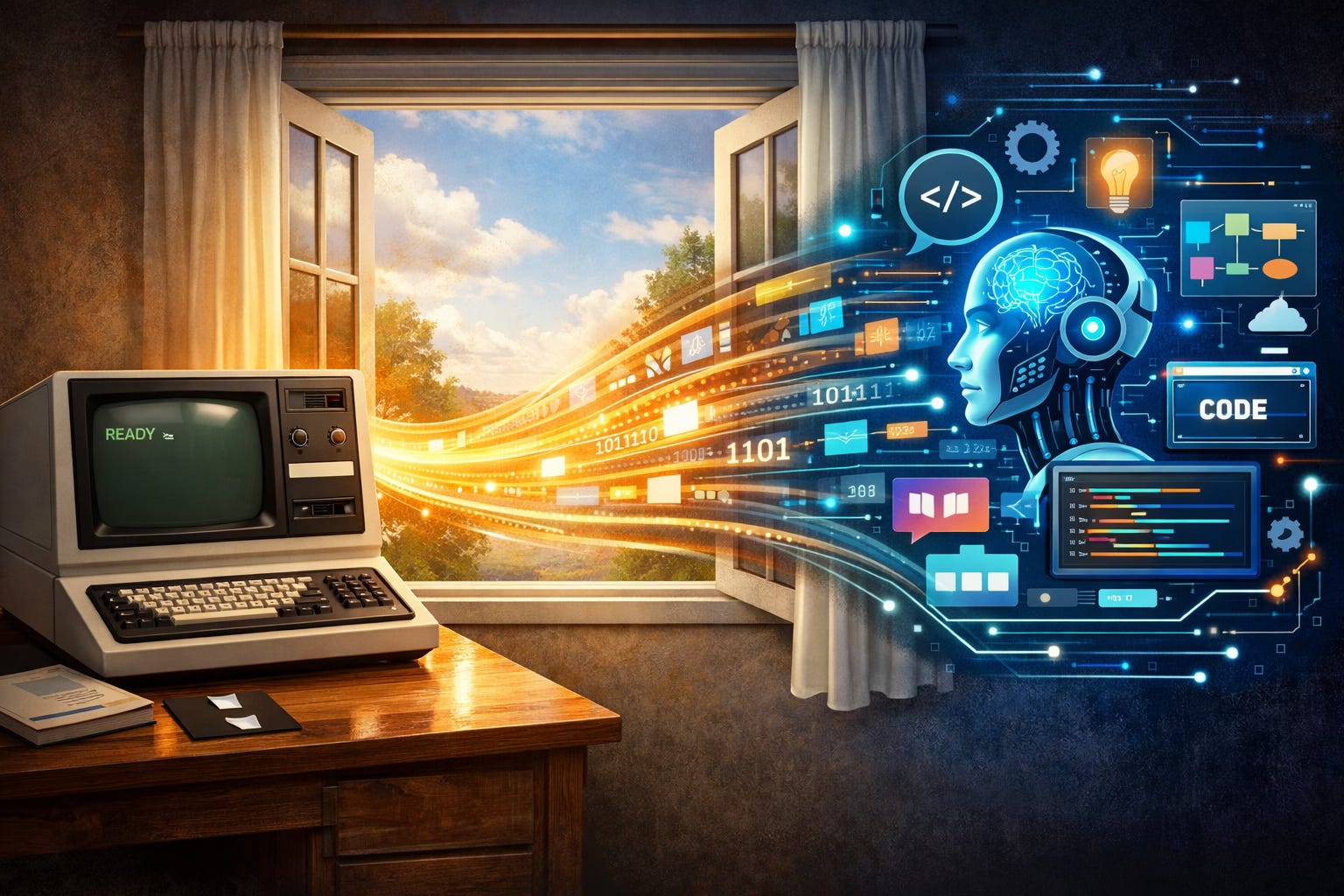
Technology is change. We might not like it, but that’s what we signed up for when we became software developers. If I hadn’t been willing to change, I’d still be writing BASIC programs on a TRS-80. Or more likely, sitting in a bar somewhere complaining about how much better the world was when I was writing BASIC programs on a TRS-80. That ain’t for me.
Maybe society will collapse when we all lose our jobs to AI. Maybe we’ll lose our retirement savings when the AI companies fail. Whatever happens, few of us are in any position to change it. You’re either prepared for it or you’re not. I’ll face it with my eyes open.